A world model is an AI system's internal model of how an environment works. Given what it observes now, and often an action, it predicts what happens next, so the system can plan or rehearse in its head before acting in the real world. The modern machine-learning version comes from David Ha and Jürgen Schmidhuber's 2018 paper World Models. Meta describes the idea the same way: an internal simulator an agent uses to imagine the consequences of an action before taking it (Meta AI, June 2025).
The term now covers at least three kinds of system, and it is often stretched to cover a fourth thing it isn't: software that understands one room from one photo. This guide sorts the meanings, lists real examples with their sources, and explains where spatial AI in retail fits.
Where the idea comes from
The idea is older than deep learning. In 1943 the psychologist Kenneth Craik argued in The Nature of Explanation that the mind carries a "small-scale model" of reality and uses it to try out actions before committing to them. Model-based reinforcement learning took the same approach: learn how the environment responds, then plan against that learned model.
In 2018 Ha and Schmidhuber gave the term its current shape. Their agent learned a compressed model of a game environment and could be trained inside that model, its own "dream", then transferred back to the real game (arXiv:1803.10122). The Dreamer line of agents pushed this further. DreamerV3 learns a model of its environment and improves its behaviour by imagining possible futures, and its authors report it was the first method to collect diamonds in Minecraft from scratch without human demonstrations (Hafner et al., 2023).
World models in AI today: three meanings
Labs use "world model" for three related but different things. What they share is prediction of how a world behaves. What differs is the output: an internal state, a world you can walk around in, or a video.
1. Predictive models for agents and robots
These models learn the dynamics of an environment and plan with them. Meta's V-JEPA 2, released in June 2025, was trained mainly on video and then on a small amount of robot data. Meta says it can plan pick-and-place actions for a robot in new environments by imagining the result of each candidate action (Meta AI). It builds on Yann LeCun's JEPA proposal, which puts a predictive world model at the centre of an intelligent agent.
2. Interactive world generators
These generate an environment you can move through and act in, and keep it consistent while you do. Google DeepMind calls Genie 3 (August 2025) a general-purpose world model that generates interactive environments in real time, at 720p and 24 frames per second. DeepMind is open about its limits: it cannot reproduce real places with full geographic accuracy, and it supports a few minutes of continuous interaction rather than hours (Google DeepMind).
World Labs' Marble, released to the public in November 2025, creates explorable 3D worlds from text, one or several images, video or a rough 3D layout, and exports them as Gaussian splats, meshes or video (World Labs).
3. World simulators and world foundation models
These are large video or physics models used to simulate the world, often to make training data for robots and self-driving systems. OpenAI framed its Sora video model this way in February 2024, in a report titled Video generation models as world simulators. NVIDIA's Cosmos platform (January 2025) offers "world foundation models" that developers fine-tune for physical AI (arXiv:2501.03575).
World model vs large language model
A large language model (LLM) predicts the next token of text. A world model predicts the next state of an environment. The two overlap, since text describes the world, but they are trained on different things for different jobs.
Fei-Fei Li argues in From Words to Worlds (November 2025) that language models are strong on abstract knowledge but weak at spatial tasks: judging distance, rotating objects in the mind, predicting simple physics. She calls them "wordsmiths in the dark". Research backs up part of that. The Thinking in Space study (Yang, Yang, Gupta, Han, Fei-Fei Li and Xie; CVPR 2025) built a benchmark of more than 5,000 spatial questions, VSI-Bench, and found multimodal LLMs show competitive but still subhuman visual-spatial reasoning.
Whether LLMs form partial world models inside them is an open debate. The same study finds signs of local world models emerging. What is clear is that they are not trained as world models in the Ha and Schmidhuber or LeCun sense.
World model examples
| System | Lab | Year | What it predicts or generates | Source |
|---|---|---|---|---|
| World Models | Ha and Schmidhuber | 2018 | A compressed model of a game environment an agent can train inside | arXiv:1803.10122 |
| DreamerV3 | Hafner et al. | 2023 | Future states, imagined to improve an agent's behaviour | arXiv:2301.04104 |
| Sora (as framed by OpenAI) | OpenAI | 2024 | Video, presented as a step toward world simulators | OpenAI research report |
| Cosmos | NVIDIA | 2025 | World foundation models for physical AI, fine-tuned per use | arXiv:2501.03575 |
| V-JEPA 2 | Meta | 2025 | How a scene changes after an action, used for robot planning | Meta AI blog |
| Genie 3 | Google DeepMind | 2025 | Interactive, navigable environments generated in real time | DeepMind blog |
| Marble | World Labs | 2025 | Explorable 3D worlds from text, images, video or layouts | World Labs blog |
Spatial AI and world models: what retail actually uses today
A world model needs, among other things, a sense of space: where the surfaces are and how big things are. Spatial AI for retail does that perception part, for one moment, in one room.
Here is a concrete case. The Imersian Visualizer takes one photo of a shopper's room and works out the floor, walls, depth and scale. That is 2.5D spatial reconstruction from a single photo, explained further under room reconstruction. A rug or sofa then appears at true scale, with real shadows and correct occlusion, from the room's real geometry rather than a generated approximation. No app, markers or LiDAR are needed.

So is Imersian a world model? No. The Visualizer does not predict how the room changes over time, it does not simulate physics, and it does not invent the room. That is the key difference from a world generator.
The difference matters to a shopper. A generated world is designed to look plausible. A buying decision needs the real room at the real size, with the real product in it. That is why retail room visualizers start from the shopper's own photo, and why spatial commerce is built on perception rather than generation.
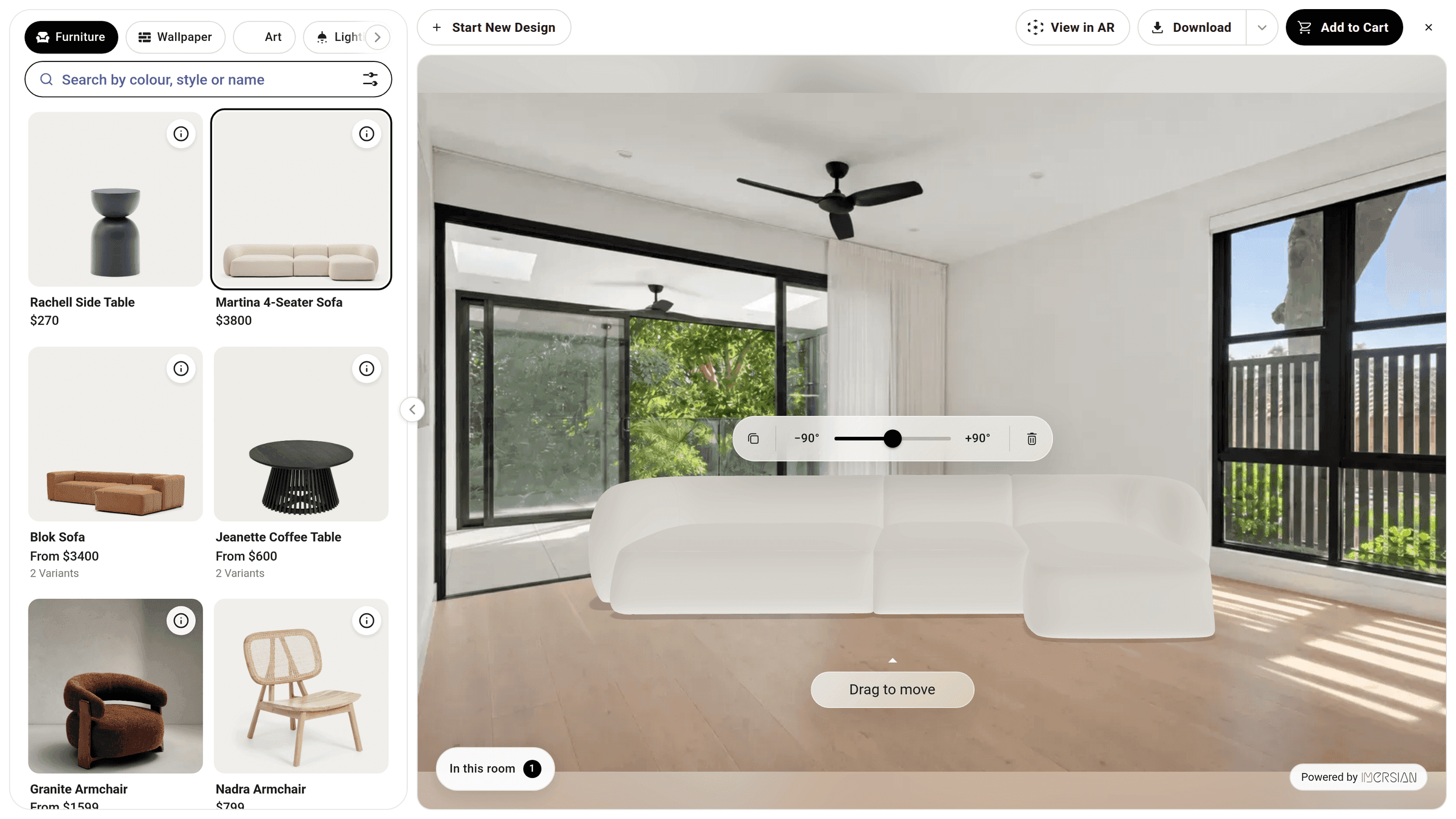
Our view, as an industry outlook. Spatial perception and world models are likely to keep converging across the field, as Fei-Fei Li argues in her essay on spatial intelligence. For a shopper deciding whether a rug fits, the job today is narrower and works now: read the real room, place the real product. You can see spatial AI in a real store.
Last reviewed 4 November 2026. This field moves fast; we review this page every six months.