What Is 3D Reconstruction?
3D reconstruction is the process of capturing the shape, structure, and appearance of real-world objects or environments and representing them as accurate three-dimensional digital models. Rather than relying on a single flat photograph, 3D reconstruction synthesizes data from multiple sources — cameras, sensors, or structured light — to build a model that can be viewed, rotated, measured, and rendered from any angle.
At its core, the technology answers a deceptively simple question: given a set of observations of an object, how do we infer its true three-dimensional form? The answer draws on computer vision, computational geometry, machine learning, and optics.
Four foundational methods power most 3D reconstruction pipelines today:
| Method | How it works | Strength |
|---|---|---|
| Photogrammetry | Matches feature points across overlapping photos and triangulates them into a point cloud | Textured models from an ordinary camera |
| LiDAR | Times laser pulses as they return from surfaces | Very precise geometry, even in difficult light; now in flagship phones |
| Neural Radiance Fields (NeRF) | A neural network learns the scene as a continuous volume from posed images | Photorealistic novel views, including translucency and reflections |
| Structured light | Projects known patterns and reads depth from their distortion | Desktop 3D scanners and face-recognition sensors |
These methods are not mutually exclusive. Modern pipelines often combine several approaches — for example, using LiDAR for coarse geometry and photogrammetry for high-resolution texture — to achieve the best balance of speed, accuracy, and cost.
A Brief History and Evolution of 3D Reconstruction
The ambition to reconstruct three-dimensional reality from two-dimensional images is nearly as old as photography itself. Stereophotogrammetry — using pairs of offset photographs to infer depth — was used in cartography and military reconnaissance as early as the late 19th century.
The digital era transformed the field. In the 1980s and 1990s, researchers developed structure-from-motion (SfM) algorithms that could automatically recover camera positions and sparse 3D structure from unordered image collections. By the 2000s, multi-view stereo (MVS) algorithms extended this to dense reconstructions, and laser scanning became practical for industrial and heritage applications.
The 2010s brought two seismic shifts. First, GPU acceleration made it feasible to process millions of points in minutes rather than hours. Second, deep learning began to outperform classical algorithms on tasks like depth estimation, feature matching, and surface completion. Consumer-grade tools like Autodesk ReCap and Agisoft Metashape democratized photogrammetry for architects, archaeologists, and product designers.
The 2020s have been defined by neural methods. NeRF, introduced by Mildenhall et al. in 2020, demonstrated that a neural network could learn a scene representation capable of rendering photorealistic novel views. Gaussian Splatting, introduced in 2023, achieved real-time rendering of NeRF-quality scenes. Meanwhile, Apple’s integration of LiDAR into the iPhone 12 Pro put a capable depth sensor in millions of pockets overnight. The trajectory is clear: 3D reconstruction is moving from specialist labs to everyday devices.
Core Techniques Used Today
Modern ecommerce 3D pipelines draw on a toolkit of complementary techniques, each with distinct trade-offs.
Photogrammetry remains the workhorse for product digitization. A turntable rig with a calibrated camera can capture hundreds of images of a product in minutes; software then produces a textured mesh ready for web delivery. It scales well and requires no specialized hardware beyond a good camera and controlled lighting.
Depth sensing — via LiDAR, structured light, or time-of-flight cameras — captures geometry directly rather than inferring it from color. This makes it faster and more robust for objects with uniform or reflective surfaces that confuse photogrammetry. The trade-off is that depth sensors typically produce lower-resolution geometry than photogrammetry at equivalent cost.
Multi-view stereo (MVS) algorithms reconstruct dense geometry by finding pixel-level correspondences across many images. Combined with SfM for camera pose estimation, MVS pipelines are the backbone of most photogrammetry software and can produce models with sub-millimeter accuracy under controlled conditions.
NeRF and Gaussian Splatting represent the frontier. NeRF models excel at capturing view-dependent effects — the way a glossy sneaker changes appearance as you rotate it — that are notoriously difficult for mesh-based methods. Gaussian Splatting achieves similar quality with dramatically faster rendering, making it viable for real-time web delivery. Both methods are rapidly maturing from research curiosities into production tools.
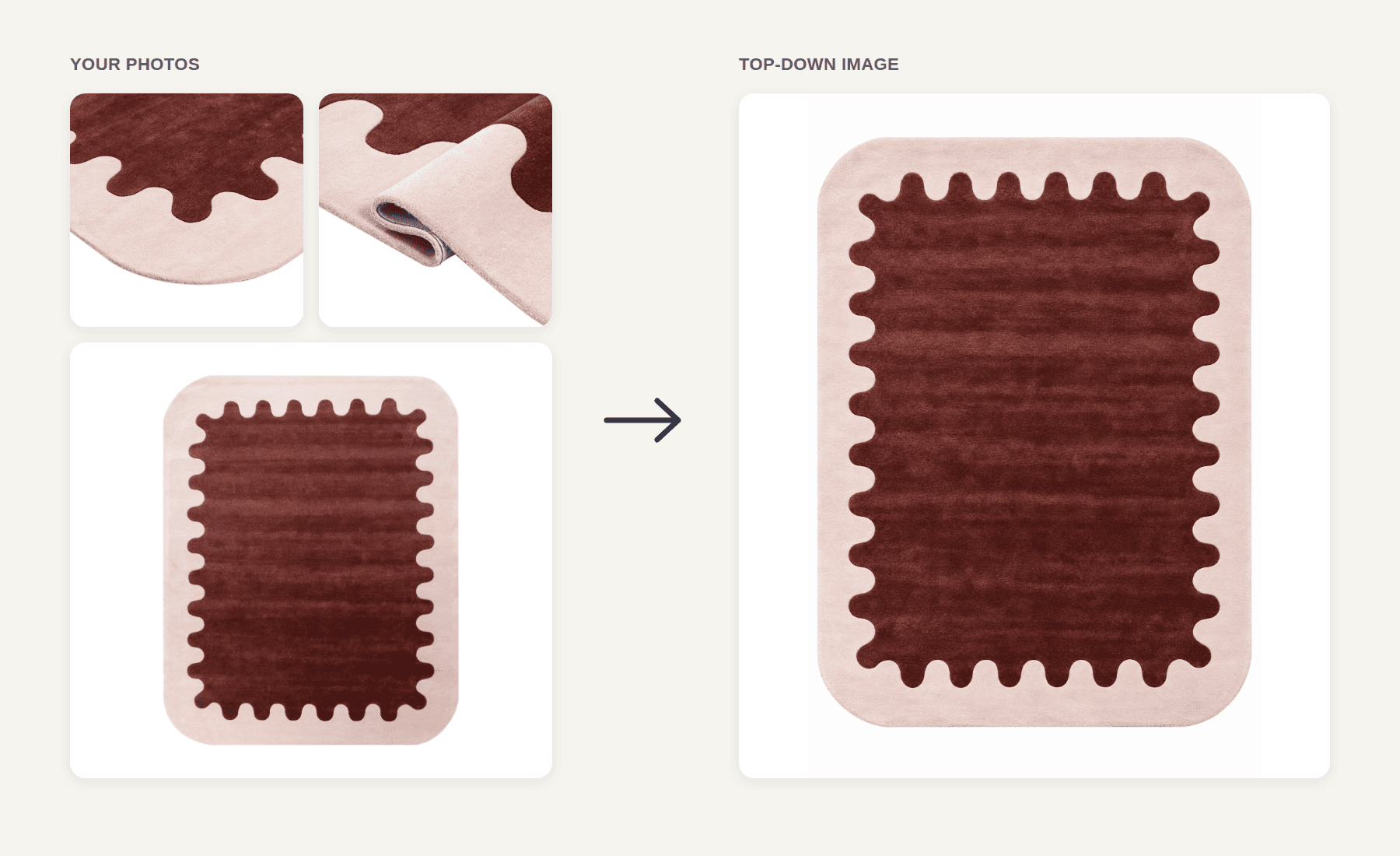
AI-driven reconstruction encompasses a growing family of techniques that use neural networks to fill gaps, sharpen details, or infer geometry from a single image. Single-image 3D reconstruction — generating a plausible 3D model from one photograph — is still imperfect, but improving rapidly. For ecommerce, this opens the possibility of retroactively creating 3D assets from existing product photography libraries.
3D Reconstruction in Ecommerce
Ecommerce has always faced a fundamental limitation: shoppers cannot touch, hold, or try on products before buying. 3D reconstruction is the most powerful tool the industry has found to close that gap. Its applications span the entire product lifecycle, from content creation to post-purchase experience.
Creating Photorealistic 3D Product Models
The most direct application is digitizing physical products into high-fidelity 3D models. A reconstructed model captures geometry, surface texture, material properties, and color with a fidelity that studio photography cannot match from every angle. Once created, a single model can be rendered in any context — on a white background, in a lifestyle scene, or inside an AR experience — eliminating the need for repeated photo shoots as marketing needs evolve.
Some large brands run dedicated digitization studios with multi-camera rigs. Others generate 3D models from the product photos they already have. Either way, the resulting assets feed directly into product detail pages, marketing campaigns, and immersive experiences, shortening content production timelines.
AR Try-On and Virtual Product Placement
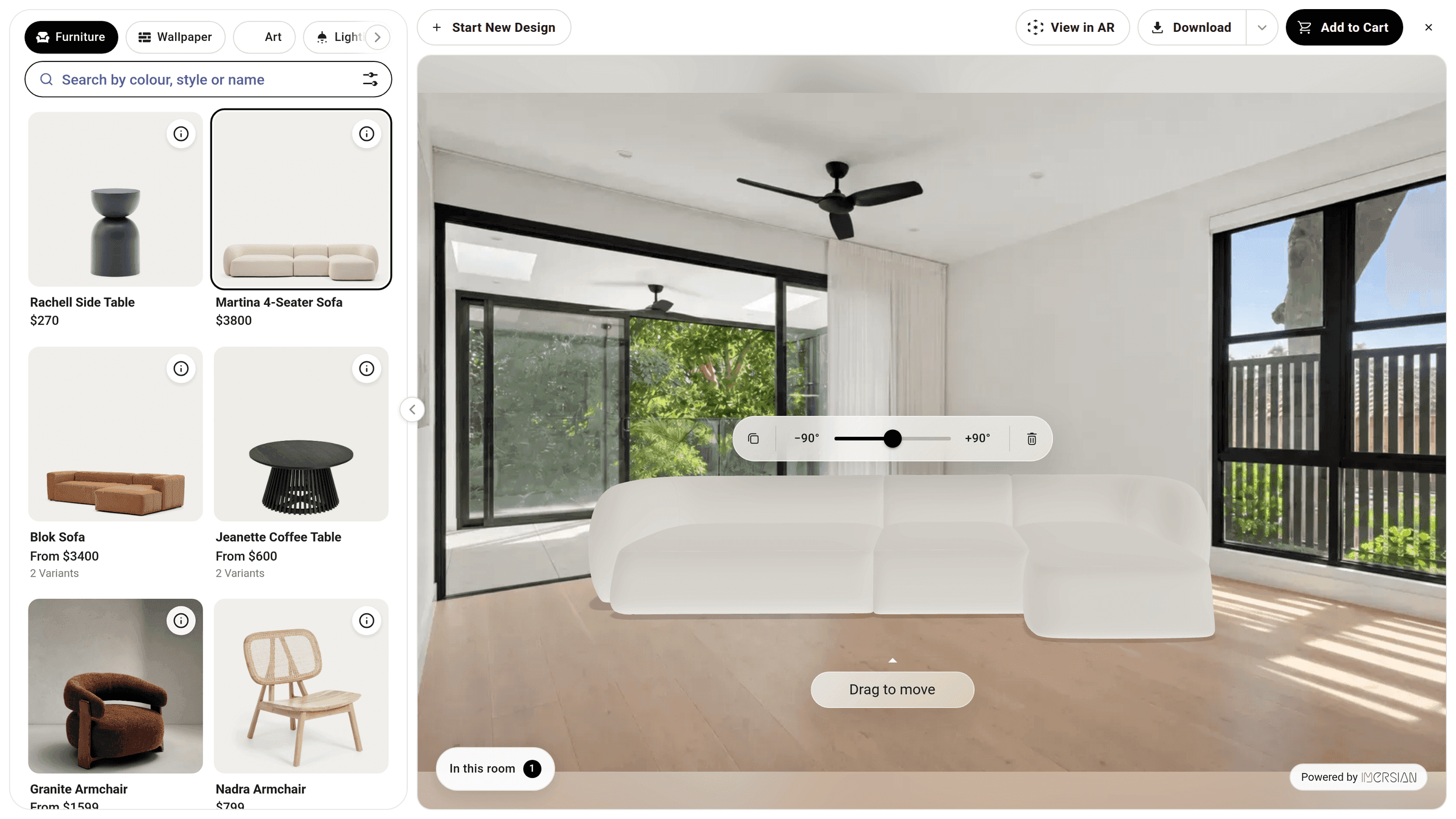
Augmented reality experiences powered by 3D models allow shoppers to place products in their own environment before purchasing. A customer can see how a sofa looks in their living room, whether a pair of glasses suits their face, or how a new sneaker pairs with their outfit — all without leaving the product page.
Platforms like Apple’s ARKit, Google’s ARCore, and WebXR have made AR delivery frictionless on modern smartphones. The quality of the AR experience depends directly on the quality of the underlying 3D model: accurate geometry ensures the product sits correctly in the scene, while high-resolution textures make it look convincingly real.
Reducing Returns
Returns are one of ecommerce’s most costly problems, especially in fashion, footwear and furniture. A significant proportion of returns are driven by unmet expectations — the product looks different in person than it did online. 3D models and AR experiences set more accurate expectations by showing products at true scale, in realistic lighting, and from every angle.
Retailers who have deployed 3D and AR consistently report meaningful reductions in return rates. When a customer has already “placed” a piece of furniture in their home via AR, they are far less likely to be surprised when it arrives.
360° Spin Views and Product Visualization
Even without full AR, 3D models enable interactive 360° spin views that dramatically outperform static image galleries. Shoppers can rotate a product, zoom into details, and examine it from angles that a photographer might never have captured. This interactivity increases time on page, reduces uncertainty, and builds purchase confidence.
WebGL-based 3D viewers have matured to the point where a high-quality interactive model loads in seconds on a standard mobile connection. Formats like glTF and USDZ have become industry standards for web and AR delivery respectively, ensuring broad compatibility across devices and platforms.
Virtual Showrooms
3D reconstruction enables brands to build fully immersive virtual showrooms — digital environments where shoppers can browse curated product collections as if walking through a physical store. These experiences are particularly powerful for furniture, home decor, and luxury goods, where context and curation are central to the brand proposition.
Virtual showrooms can be updated instantly as inventory changes, personalized to individual shoppers, and accessed from anywhere in the world — advantages that no physical retail space can match.
Accelerating Content Production
Perhaps the most underappreciated benefit of 3D reconstruction is its impact on content production efficiency. A single high-quality 3D asset can generate an unlimited number of rendered images: different backgrounds, lighting conditions, color variants, and lifestyle contexts, without booking a new photo shoot for each one.
Real-World Use Cases
The adoption of 3D reconstruction in ecommerce is no longer theoretical. Across categories, leading brands are deploying the technology at scale.
Furniture and home decor were early adopters, driven by the obvious value of AR placement. IKEA launched its IKEA Place AR app in 2017, and Wayfair lets shoppers view many of its products in their own rooms through AR.
Fashion and apparel brands are using 3D reconstruction to create virtual try-on experiences for clothing and accessories. Reconstructed garments can be draped over avatar bodies that match a shopper’s measurements, giving a realistic preview of fit and drape without a physical sample.
Footwear is one of the highest-return categories in ecommerce, making it a natural fit for 3D and AR. Nike, Adidas, and a growing number of DTC sneaker brands offer AR try-on experiences that let shoppers see shoes on their own feet via their smartphone camera.
Consumer electronics brands use 3D models to showcase product design details — port placement, button layout, material finish — that are difficult to convey in flat photography. Interactive 3D viewers on product pages allow shoppers to inspect a laptop or camera from every angle before committing to a purchase.
Business Impact
The business case for 3D reconstruction in ecommerce is increasingly well-documented. Across deployments, three metrics stand out.
Conversion rates improve when shoppers can interact with 3D models or AR experiences. Shopify reports that merchants who add 3D content to their stores see a 94% conversion lift on average (Shopify, May 2022). The effect is strongest for high-consideration purchases where uncertainty is a major barrier.
Return rates fall when expectations are set accurately. Gunner Kennels, for example, reduced its return rate by 5% after adding 3D models and AR to its product pages, according to Shopify’s case study. Because every return costs shipping and handling, even modest reductions matter to the bottom line.
Customer engagement deepens with interactive 3D content. Shoppers who interact with a 3D viewer spend more time on the product page, are more likely to share the product, and report higher satisfaction with the shopping experience. This engagement translates into stronger brand affinity and higher lifetime value.
Challenges and Limitations
Despite its promise, 3D reconstruction in ecommerce is not without friction. Brands considering adoption should understand the real challenges.
Cost and infrastructure remain significant barriers for smaller retailers. Building a high-throughput digitization studio requires capital investment in hardware, software, and skilled operators. While costs are falling rapidly, the economics still favor large catalogs and high-margin products.
Processing time has improved dramatically but is not yet instant. A complex product with fine details — a woven textile, a piece of jewelry with intricate metalwork — may require hours of capture and processing to achieve acceptable quality. Automated pipelines are reducing this, but human review and cleanup remain necessary for many SKUs.
Accuracy and quality consistency across a large catalog is difficult to maintain. Variations in lighting, capture conditions, and operator technique can produce inconsistent results that undermine the brand experience. Standardized workflows and quality control processes are essential but add overhead.
Device compatibility for AR experiences remains uneven. While modern flagship smartphones handle AR well, older devices and budget handsets may not support the required capabilities. WebXR is improving cross-platform reach, but brands must still design experiences that degrade gracefully for users on less capable hardware.
The Future of 3D Reconstruction in Ecommerce
The trajectory of 3D reconstruction technology points toward a future where creating and delivering immersive product experiences is as routine as taking a photograph today.
AI acceleration is compressing reconstruction pipelines from hours to minutes — and in some cases, seconds. Foundation models trained on billions of images are enabling single-image 3D reconstruction of sufficient quality for many ecommerce use cases, potentially allowing brands to generate 3D assets from their existing photography libraries without new capture.
Smartphone scanning is putting professional-grade capture capability in the hands of brand partners, suppliers, and even consumers. As LiDAR and advanced computational photography become standard on mid-range devices, the cost and complexity of 3D capture will continue to fall. Brands will increasingly be able to crowdsource 3D capture from their supply chain.
WebGL and WebXR delivery are maturing rapidly, making it possible to deliver high-quality 3D and AR experiences directly in the browser without requiring app downloads. As these standards are adopted more broadly and network speeds increase, the friction of accessing immersive product experiences will approach zero.
The convergence of these trends suggests that within the next three to five years, 3D product representation will shift from a competitive differentiator to a baseline expectation — much as high-resolution photography did in the previous decade.
Conclusion
3D reconstruction is not a niche technology or a distant aspiration. It is a mature, rapidly evolving capability that forward-thinking ecommerce brands are deploying today to create better shopping experiences, reduce costly returns, and build stronger customer relationships. The brands that invest in 3D pipelines now — building the workflows, asset libraries, and delivery infrastructure — will be best positioned as the technology becomes the new standard for online retail.
The question for ecommerce leaders is no longer whether 3D reconstruction matters. It is how quickly they can make it central to their product experience strategy.